
Packaging is a critical stage in manufacturing because it prepares finished products for storage, transportation, and delivery to customers. The way businesses manage this stage can influence production speed, labor requirements, product protection, and overall operating costs. While some manufacturers continue to depend on manual packaging methods, others are adopting automated systems to improve consistency and handle increasing production demands.
End of Line Packaging Automation provides an alternative to traditional manual processes by using machinery and integrated control systems to complete activities such as carton forming, case packing, sealing, labeling, palletizing, and wrapping. Both approaches have advantages and limitations, so manufacturers should understand their differences before deciding which method best suits their operations.
Understanding Manual Packaging Processes
Manual packaging involves employees performing most or all final packaging activities without fully automated machinery.
Depending on the production environment, workers may prepare cartons, place products inside boxes, apply tape, attach labels, arrange packages, and stack finished cartons onto pallets.
This approach is commonly used by small manufacturers, businesses with limited production volumes, and facilities that handle products requiring frequent manual inspection or specialized handling.
Manual packaging can be relatively simple to establish because it may require fewer equipment investments. However, its performance often depends on workforce availability, employee experience, physical workload, and production conditions.
Understanding End-of-Line Packaging Automation
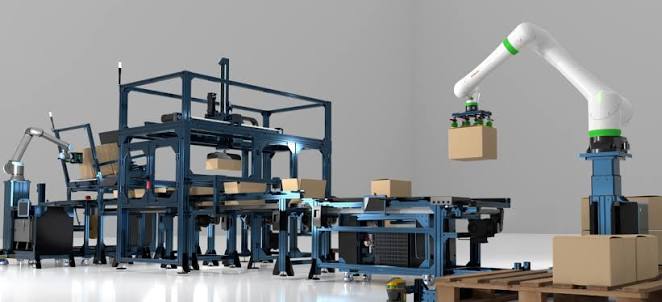
End-of-line packaging automation uses machinery to perform multiple final packaging operations with limited direct human involvement.
A typical automated system may include:
- Automatic carton erectors for preparing shipping boxes.
- Case packers for loading products into cartons.
- Carton sealers for closing packages.
- Labeling and coding machines for product identification.
- Conveyor systems for transporting products between stations.
- Robotic or conventional palletizers for arranging cartons.
- Stretch wrappers for stabilizing pallet loads.
These machines can operate individually or as interconnected components of a complete packaging line.
The objective is to create a coordinated process that moves finished products from the production area to the warehouse with fewer manual interruptions.
1. Production Speed and Throughput
Production speed is one of the most noticeable differences between manual and automated packaging.
In manual operations, employees perform repetitive tasks at a pace influenced by experience, workload, fatigue, and staffing levels. When production output increases, additional workers may be required to maintain the packaging schedule.
Automated equipment performs programmed operations at controlled speeds. Case packers, carton sealers, and palletizers can process products continuously when supplied with materials and properly synchronized.
This can help manufacturers increase throughput and reduce delays between packaging stages.
However, actual performance depends on machine capacity, product characteristics, changeover requirements, and the speed of the complete production line.
2. Labor Requirements
Manual packaging requires employees to handle many repetitive activities, including folding cartons, loading products, sealing boxes, and stacking packages.
As production volumes grow, businesses may need to recruit additional workers or extend operating shifts.
Automation reduces the need for direct employee involvement in selected repetitive tasks. Machines can handle carton preparation, product loading, sealing, and palletizing, allowing employees to focus on supervision, inspection, and maintenance.
Although automated systems still require trained personnel, they can improve how businesses allocate their workforce.
3. Packaging Consistency and Accuracy
Maintaining consistent packaging quality is important for product protection and customer satisfaction.
Manual packaging may produce variations in carton arrangement, tape application, product positioning, and pallet stacking. These differences can occur because employees use different techniques or work under changing conditions.
Automated equipment follows programmed settings and repeatable operating sequences.
For example, carton sealing machines apply closures consistently, while robotic palletizers follow predefined stacking patterns.
This helps manufacturers achieve more uniform packaging results, although proper machine calibration and maintenance remain necessary.
4. Initial Investment and Operating Costs
Cost is an important consideration when comparing manual and automated packaging.
Manual operations generally require less initial spending on machinery. Businesses may need workstations, basic packaging tools, cartons, tape, and other consumables.
However, ongoing labor expenses can become significant when production volumes increase.
Automated systems require a larger initial investment because businesses must purchase machinery, conveyors, control equipment, and integration services. Installation, training, spare parts, and maintenance also contribute to the total cost.
Over time, automation may reduce certain labor expenses, packaging waste, and production interruptions.
Manufacturers should compare the total cost of ownership rather than evaluating equipment based only on its purchase price.
5. Product Protection and Packaging Quality
The final packaging process helps protect finished products from damage during storage and transportation.
Manual operations can provide flexibility when employees need to handle fragile or unusual products. However, inconsistent carton filling, sealing, or pallet stacking may increase the risk of damage.
Automated packaging equipment can improve consistency through controlled product positioning, standardized carton sealing, and programmed pallet arrangements.
Stretch wrapping machines can also help stabilize pallet loads during transportation.
The appropriate approach depends on product characteristics, packaging materials, and the level of protection required.
6. Workplace Safety and Physical Demands
Manual packaging can involve repetitive lifting, bending, carrying, and stacking. These activities may create physical strain, particularly when employees handle heavy cartons or work for extended periods.
Automation can reduce the need for certain repetitive manual tasks.
For example, robotic palletizers can arrange cartons onto pallets, while conveyors transport products between packaging stations.
However, automated machinery introduces its own safety considerations. Moving robotic arms, conveyors, and mechanical components require suitable guarding, emergency stops, safety sensors, and operator training.
Both approaches require appropriate workplace safety practices, but automation can reduce exposure to some physically demanding activities.
7. Flexibility for Different Products
Manual packaging can be useful for businesses that handle small quantities, irregular product shapes, or frequent packaging changes.
Employees can adjust their handling methods without requiring extensive machine reprogramming.
Automated systems may require setup changes, different gripping tools, or new operating recipes when product dimensions and packaging formats change.
However, modern robotic systems and adjustable packaging machines can support multiple product types.
The most suitable choice depends on how frequently products change and whether the equipment can accommodate the required packaging variations.
8. Production Scalability
Manual packaging may be practical when production volumes are low and relatively stable.
However, expanding manual operations usually requires additional employees, workstations, and floor space.
Automated packaging systems can offer a different path to growth. Businesses may increase operating hours, upgrade selected machines, or add additional packaging stations to improve capacity.
Modular equipment can make future expansion easier because manufacturers can automate operations gradually.
For companies expecting long-term production growth, scalability should be considered during the initial equipment selection process.
9. Packaging Waste and Material Consumption
Packaging materials contribute to manufacturing expenses, and unnecessary consumption can increase operating costs.
Manual operations may involve inconsistent tape application, excessive wrapping, damaged cartons, or incorrect package preparation.
Automated machines can help regulate material usage through controlled settings.
For example, stretch wrapping systems can adjust film application according to load requirements, while automatic carton formers prepare boxes using predefined dimensions.
Automation does not eliminate packaging waste entirely, but it can help reduce certain sources of material inconsistency.
10. Maintenance and Downtime
Manual packaging relies heavily on employee availability and the condition of basic packaging tools. Maintenance requirements are generally limited compared with complex automated machinery.
Automated packaging systems contain mechanical, electrical, pneumatic, and control components that require regular inspection and servicing.
A machine breakdown can interrupt several connected packaging operations if the line is not designed with suitable backup arrangements or accumulation capacity.
Manufacturers should consider preventive maintenance schedules, spare parts availability, technical support, and equipment reliability before investing in automation.
11. Quality Control and Product Traceability
Manual packaging quality checks often depend on employee inspection and documentation.
Although workers can identify visible defects, checking every package manually may be difficult in high-volume operations.
Automated packaging lines can integrate inspection equipment such as checkweighers, barcode scanners, machine vision systems, and coding devices.
These technologies can help verify package weight, identify labeling problems, and record product information.
When connected with manufacturing or warehouse software, automated systems can also support better product traceability and inventory management.
Key Differences Between Automated and Manual Packaging
| Comparison factor | Manual packaging | Automated packaging |
|---|---|---|
| Production speed | Depends on employee performance | Controlled by machine capacity |
| Labor requirements | Higher direct involvement | Lower involvement in repetitive tasks |
| Initial investment | Generally lower | Generally higher |
| Packaging consistency | Can vary between operators | More repeatable with proper setup |
| Product flexibility | Easy to adjust manually | Depends on machine configuration |
| Scalability | Often requires additional workers | May support equipment upgrades |
| Maintenance | Relatively simple | Requires technical servicing |
| Material control | Depends on operator practices | Can use programmed material settings |
| Safety considerations | Repetitive physical handling | Requires machine safety systems |
| Production monitoring | Often relies on manual records | Can provide automated operating data |
When Is Manual Packaging the Better Choice?
Manual packaging can remain a practical option for certain manufacturing businesses.
It may be suitable when:
- Production volumes are relatively low.
- Products have unusual shapes or handling requirements.
- Packaging specifications change frequently.
- Available investment capital is limited.
- The business operates with a small product range and manageable order volumes.
- Manual inspection is an important part of the packaging process.
For these operations, investing in a complete automated line may not provide sufficient financial or operational benefits.
When Should Businesses Choose Automation?
Automated packaging becomes more attractive when manufacturers experience increasing production volumes or repeated problems with manual operations.
It may be particularly useful when:
- Production schedules require consistent high-volume output.
- Manual packaging creates recurring bottlenecks.
- Repetitive tasks place physical demands on employees.
- Packaging consistency is important.
- The business needs faster carton packing and palletizing.
- Product identification and traceability requirements are increasing.
- Future production growth is expected.
Businesses do not necessarily need to automate every operation at once. They can begin with high-impact activities such as carton sealing or palletizing and expand the system over time.
Can Manual and Automated Packaging Work Together?
Many manufacturers use a combination of manual and automated processes rather than choosing only one approach.
For example, employees may perform product inspection and prepare packaging materials, while automatic machines handle carton forming, case packing, sealing, and palletizing.
This hybrid approach allows businesses to automate repetitive activities while retaining human involvement in tasks that require flexibility or judgment.
It can also provide a gradual transition for manufacturers that are not ready to invest in a fully integrated packaging line.
Conclusion
End-of-line packaging automation and manual packaging processes serve different manufacturing requirements. Manual methods offer simplicity and flexibility for smaller operations, while automated systems can provide higher throughput, consistent packaging, reduced repetitive labor, and improved material handling for businesses with greater production demands.
The right choice depends on production volume, product characteristics, labor availability, investment capacity, and long-term business objectives. Some manufacturers may benefit from partial automation, while others may require a complete integrated packaging system.
Businesses evaluating their options should compare operational costs, expected output, maintenance requirements, and future expansion needs. Techflow Pack is a useful industry reference for manufacturers exploring packaging equipment and integrated solutions to improve their final packaging operations.


