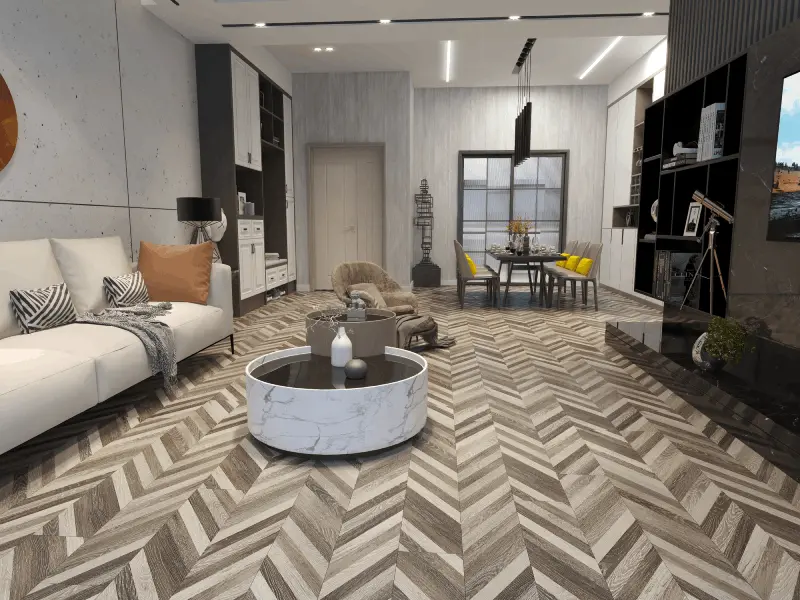
Flooring patterns influence the character of a room just as much as color and material. While straight-laid planks create a familiar linear appearance, patterned installations can introduce movement and visual structure. Chevron is one design that has remained popular in interior schemes because its angled layout creates a distinctive, orderly rhythm across the floor.
For retailers and project buyers exploring this style, choosing a suitable Chevron Vinyl Plank Supplier is an important part of the process. The design needs to be supported by flooring products made for the intended installation pattern, with clear information about dimensions, joint details, and laying instructions. A striking pattern is most successful when the material and installation plan work together.
What Makes Chevron Different?
Chevron flooring is recognized by planks arranged in angled rows that meet to form continuous V-shaped points. The ends of the pieces are typically cut at matching angles, allowing the pattern to create a repeated directional effect.
It is sometimes confused with herringbone, another classic layout. In a herringbone pattern, rectangular planks meet at right angles in a staggered arrangement. Chevron, by contrast, creates a more continuous zigzag line. The distinction affects the appearance of the floor and the type of product required.
The repeated geometry can make a room feel more structured. Depending on plank size, color, and orientation, the pattern may appear traditional, contemporary, or decorative.
Create a Focal Point Without Overcomplicating the Room
Chevron flooring can act as a visual feature in an interior. In a living room, it may draw attention toward a fireplace, window, or central seating area. In a hallway, the repeated V-shapes can emphasize the direction of movement through the space. In a boutique or reception area, the pattern can help establish a more distinctive first impression.
The effect depends on the surrounding design. A pronounced grain or high-contrast color may create a strong statement, while a pale, understated finish can provide texture without dominating the room.
When planning the interior, consider how the flooring will relate to cabinetry, wall colors, furniture, and lighting. Large samples are helpful because a small plank sample may not show how the repeated pattern will look across a full floor.
Select a Product Designed for the Pattern
Not every vinyl plank can be arranged in a chevron layout. The product needs compatible dimensions, edge profiles, and installation details. Some systems use specific left- and right-handed pieces, while others have their own defined joining arrangements.
Before ordering, ask the supplier to confirm that the product is designed for the intended pattern. Request a layout guide and check whether the installation requires separate plank types or a particular starting point. This prevents confusion when materials arrive at the site.
Review the technical specification as well. Check the construction, wear-layer details, surface finish, total thickness, and recommended applications. The appropriate specification will depend on the room’s traffic, maintenance needs, and environmental conditions.
Plan the Layout Before Installation
Chevron layouts require careful setting out. The installer should establish a centerline or other approved reference and calculate how the pattern will finish at walls, doorways, and transitions. Poor planning can result in narrow cuts or an uneven-looking pattern at the edges of the room.
Room dimensions and the direction of natural light may influence the preferred layout. The pattern should also be coordinated between connected spaces if visual continuity is important.
As with other vinyl flooring installations, subfloor preparation is essential. Follow the manufacturer’s instructions for flatness, moisture, cleanliness, expansion details, and installation conditions. The installer should use the specified method rather than adapting instructions intended for a different flooring system.
Balance Appearance with Practical Requirements
A decorative pattern does not remove the need to consider everyday use. Evaluate the product’s surface durability, cleaning recommendations, slip-related information where relevant, and suitability for the intended environment. Ask for supporting documentation if the project has formal performance requirements.
Choose a Supplier Who Understands the Details
A knowledgeable supplier should be able to explain product orientation, compatible components, installation requirements, and available finishes. Clear samples and technical documents make it easier for designers and installers to coordinate their work.
Chevron vinyl plank offers a distinctive alternative to conventional straight-laid flooring. With a suitable product, a carefully planned layout, and an installation team familiar with the pattern, it can bring direction and character to a wide range of modern interiors.