
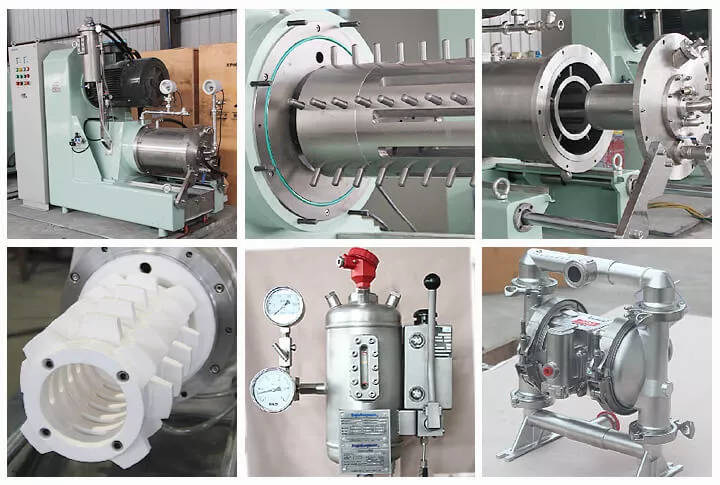
In industrial grinding and dispersion processes, maintaining consistent performance is essential for achieving high-quality output. Industries such as paints, coatings, chemicals, pharmaceuticals, and inks rely heavily on precise particle size reduction to ensure product stability and performance.
A bead mill is widely used for fine grinding and uniform dispersion in these industries. However, like any industrial equipment, operational issues can occur over time. Proper understanding of these problems and their solutions helps ensure smooth production. In fact, a well-maintained bead mill can significantly reduce downtime and improve overall efficiency.
Table of Contents
ToggleImportance of Identifying Operational Issues Early
Detecting problems at an early stage is crucial for maintaining production quality and avoiding costly breakdowns. Small issues, if ignored, can escalate into major equipment failures or product defects.
Early identification helps:
- Improve machine performance
- Reduce maintenance costs
- Maintain consistent product quality
- Prevent unexpected downtime
Common Problems in Bead Mill Operation
1. Inconsistent Particle Size Output
One of the most frequent issues is uneven particle size distribution.
Possible causes:
- Incorrect bead size selection
- Worn grinding media
- Improper rotor speed
- Irregular feed rate
Solutions:
- Select appropriate bead size for the material
- Replace worn beads regularly
- Optimize operating speed
- Maintain consistent feed flow
2. Overheating During Operation
Excess heat can affect material quality and machine stability.
Possible causes:
- Poor cooling system performance
- High rotor speed
- Continuous overload operation
Solutions:
- Improve cooling system efficiency
- Reduce operational speed when needed
- Avoid overloading the machine
3. Excessive Vibration or Noise
Unusual vibration often indicates mechanical imbalance.
Possible causes:
- Worn bearings or components
- Improper bead loading
- Misalignment of internal parts
Solutions:
- Inspect and replace damaged parts
- Ensure correct bead distribution
- Perform regular alignment checks
4. Blockage in Grinding Chamber
Material blockage reduces efficiency and disrupts flow.
Possible causes:
- High-viscosity materials
- Improper feed rate
- Accumulation of residue
Solutions:
- Adjust material viscosity before processing
- Control feed rate carefully
- Clean chamber regularly
5. Seal Leakage Issues
Leakage can lead to contamination and product loss.
Possible causes:
- Worn seals
- Excess internal pressure
- Lack of maintenance
Solutions:
- Replace seals promptly
- Maintain proper pressure levels
- Follow regular maintenance schedule
6. Poor Dispersion Quality
When dispersion is not uniform, product quality is affected.
Possible causes:
- Incorrect bead selection
- Insufficient grinding time
- Low energy input
Solutions:
- Optimize bead type and size
- Increase processing time if needed
- Adjust rotor speed and energy settings
Preventive Maintenance for Better Performance
Preventive maintenance plays a key role in reducing operational issues.
Key practices include:
- Regular inspection of grinding media
- Cleaning of internal components
- Lubrication of moving parts
- Monitoring temperature and pressure
- Timely replacement of worn parts
A structured maintenance routine ensures stable performance of a bead mill.
Operational Best Practices
To minimize problems, operators should follow best practices:
- Maintain steady feed rate
- Avoid overloading the system
- Monitor machine parameters regularly
- Use correct bead size and type
- Follow manufacturer guidelines
These practices help maintain consistent output quality and reduce downtime.
Conclusion
Understanding common operational problems and their solutions is essential for efficient industrial grinding processes. A properly maintained bead mill ensures stable performance, consistent particle size reduction, and high-quality dispersion.
By identifying issues early and applying corrective measures, manufacturers can improve productivity, reduce operational costs, and extend machine lifespan.

