
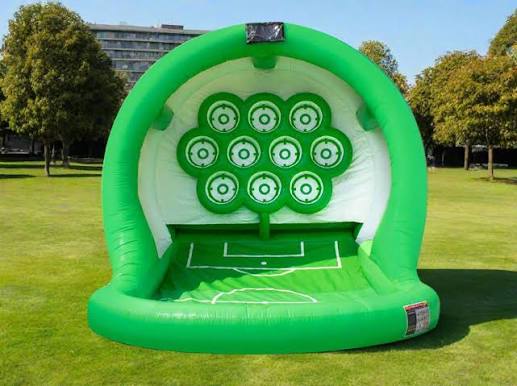
The Difference Between Traditional Inflatables and Inflatable Interactive Games
Inflatable attractions have become popular at birthday parties, festivals, amusement centers, school events, and corporate gatherings. Their bright colors, flexible designs, and variety of activities make them appealing to audiences of different ages. However, not all inflatables provide the same experience. Traditional inflatables generally focus on physical play, such as bouncing, sliding, or climbing, while newer interactive attractions emphasize participation through challenges, competition, and skill-based activities.
For event organizers and commercial entertainment operators, understanding the differences between traditional inflatables and Inflatable Interactive Games can help them choose equipment that matches their audience, available space, and business goals. Although both options can encourage active participation, they differ in game structure, user engagement, operational requirements, and potential applications. Comparing these features makes it easier to determine which type of inflatable offers the best fit for a particular venue or event.
1. What Are Traditional Inflatables?
Traditional inflatables are air-supported structures designed primarily for recreational physical activities. They are commonly used at children’s parties, community celebrations, school fairs, family entertainment centers, and outdoor festivals.
Typical examples include:
- Inflatable bounce houses: Enclosed or partially enclosed areas designed for bouncing and jumping.
- Inflatable slides: Attractions that allow participants to climb designated steps and slide down.
- Inflatable obstacle courses: Structures featuring tunnels, barriers, climbing sections, and other physical challenges.
- Inflatable play zones: Open or enclosed areas that provide space for general movement and age-appropriate play.
- Inflatable combo units: Products that combine activities such as bouncing, climbing, and sliding in one structure.
The primary purpose of traditional inflatables is to provide an enjoyable physical play environment. Many designs rely on relatively simple rules, making them easy for visitors to understand.
For commercial operators, traditional inflatables can be useful when the goal is to create a recognizable attraction that encourages movement and keeps participants entertained for a period of time.
2. What Are Inflatable Interactive Games?
Inflatable interactive games combine an inflatable structure with a defined activity, challenge, or objective. Instead of focusing exclusively on free play, these attractions encourage participants to complete tasks, improve their performance, or compete against other players.
Common examples include:
- Inflatable basketball games: Participants attempt to score points by shooting basketballs through designated hoops.
- Inflatable soccer target games: Players aim at marked targets or openings using a soccer ball.
- Inflatable dart-style games: Participants aim soft projectiles at a designated target using the equipment’s approved method.
- Inflatable sports challenges: Activities may involve accuracy, coordination, timing, or scoring.
- Inflatable competitive games: Players or teams complete challenges according to specific rules.
The exact features depend on the product. Some games use simple targets and manual scoring, while others may incorporate electronic scoreboards, timed rounds, or multiple activity stations.
These attractions are often suitable for settings where organizers want participants to interact with the equipment, challenge themselves, or compete in friendly games.
3. The Main Differences Between Traditional and Interactive Inflatables
Although both categories use inflatable structures, their design and intended activities can be different.
| Comparison factor | Traditional inflatables | Inflatable interactive games |
|---|---|---|
| Primary purpose | General physical play and recreation | Skill-based activities, challenges, and competition |
| Typical activities | Bouncing, sliding, climbing, and navigating | Shooting, aiming, scoring, and completing objectives |
| Rules | Often simple, with an emphasis on free play | Usually include specific goals or scoring rules |
| Engagement style | Physical movement and imaginative play | Active participation with measurable objectives |
| Competition | Optional or limited in many designs | Often built into the activity |
| Audience | Frequently children and families, depending on the product | Children, teenagers, adults, families, and groups, depending on the design |
| Event applications | Birthday parties, play areas, fairs, and festivals | Team-building events, sports days, promotional activities, and festivals |
| Operational needs | Depend on size, design, and participant capacity | Depend on game mechanics, scoring, equipment, and participant flow |
These distinctions are general rather than absolute. An obstacle course can include competitive races, while an interactive game can also provide simple recreational fun. Buyers should therefore evaluate the individual product instead of relying exclusively on its category.
4. Differences in Gameplay and User Engagement
One of the clearest differences is how visitors interact with each attraction.
Traditional Inflatables Encourage Free Play
Bounce houses and general play structures give participants opportunities to jump, move, explore, and enjoy physical activity. The experience may not require a specific goal or scoring system.
This simplicity is useful for younger audiences and casual entertainment settings. Visitors can often begin playing after receiving basic safety instructions.
However, the experience can become repetitive for some audiences, particularly when the venue serves older children, teenagers, or adults who prefer activities with a defined challenge.
Interactive Games Introduce Clear Objectives
Interactive attractions provide a more structured experience. Participants might attempt to score the most points, hit a target, complete a challenge, or outperform their previous results.
Defined objectives can encourage visitors to take additional turns and invite friends to participate. They can also give event organizers an easy way to structure competitions, team activities, and scheduled challenges.
For example, a basketball shooting game can be organized into short rounds, with each participant receiving a fixed number of attempts. A soccer target attraction can use different scoring zones to create varying levels of difficulty.
The result is an activity that combines physical participation with a clear purpose.
5. Which Option Is Better for Different Age Groups?
The best choice depends on the attraction’s design, safety requirements, and intended users.
Young Children
Traditional bounce houses and age-appropriate play structures may be suitable for younger children because their activities can be relatively straightforward.
Interactive games can also work well when they feature simple rules, suitable equipment, and appropriately sized targets. Buyers should confirm the manufacturer’s age recommendations and supervision requirements.
Older Children and Teenagers
Older participants may appreciate attractions that involve competition, accuracy, speed, or coordination. Interactive sports games can offer a different experience from general bouncing and sliding.
Traditional obstacle courses can also appeal to this age group, especially when they include suitable challenges or organized races.
Adults and Corporate Groups
For adult gatherings and company events, interactive games can help create structured group activities. Teams can compete in short rounds, track scores, and encourage colleagues to participate.
Traditional inflatables may still be appropriate for adult recreation, but operators should verify that the particular model is designed and approved for the intended participants.
Families and Mixed-Age Events
Events serving a wide age range may benefit from combining different attraction types. A traditional inflatable can provide general recreation, while an interactive game offers a more structured challenge.
This combination gives guests a choice between free play and goal-oriented activities without requiring every visitor to enjoy the same type of entertainment.
6. Differences in Commercial and Event Applications
Both traditional and interactive inflatables can support commercial entertainment businesses, but they may serve different purposes.
Birthday Parties and Private Celebrations
Traditional bounce houses remain a recognizable option for children’s birthday parties and family celebrations. They offer a simple activity that can be incorporated into a larger event.
Interactive games may add variety, particularly for parties involving older children or guests who enjoy friendly competition. A target game or basketball challenge can provide a separate activity for visitors who prefer skill-based play.
Festivals and Community Events
Large public events often need attractions that can accommodate visitor interest while supporting an organized event layout.
Traditional inflatables can serve as general play areas, while interactive games can be incorporated into activity zones, sports-themed areas, or scheduled competitions.
When selecting either type, organizers should evaluate capacity, expected demand, queue management, installation space, and supervision requirements.
Corporate Team-Building Activities
Interactive games can be especially useful for team-building events because they provide clear tasks and measurable outcomes. Participants can work individually or in groups, depending on the activity’s design.
For example, colleagues may compete in basketball shooting rounds or take turns aiming at targets. These activities can create a shared experience without requiring every participant to have advanced athletic skills.
Traditional inflatables may also contribute to recreational corporate events, but interactive formats often provide a more natural structure for scoring and team challenges.
Rental Businesses and Entertainment Centers
Rental operators may benefit from offering both categories to serve different customer requirements. Traditional inflatables can meet demand for general play, while interactive games can help expand the range of available event activities.
Entertainment centers can also use a varied attraction portfolio to serve different age groups and encourage repeat visits. The right mix depends on customer preferences, local competition, space availability, and the cost of operating each product.
7. Space and Installation Requirements
The installation footprint can influence whether an inflatable is suitable for a venue.
Traditional Inflatables
Bounce houses, slides, and obstacle courses vary considerably in size. Large slides and extended obstacle courses may require substantial space, including safe access and exit areas.
Operators should consider ceiling height for indoor installations, ground conditions for outdoor use, and the anchoring arrangements specified by the manufacturer.
Interactive Inflatables
Some interactive games have a relatively compact footprint, while large sports attractions and multi-game units may require considerable space.
Their layouts may also need dedicated areas for participants to take turns, retrieve equipment, wait safely, and observe ongoing games.
The size of the inflatable alone is not enough to determine suitability. Buyers should obtain the complete installation dimensions and account for all required clearances, access routes, and operating equipment.
8. Safety Considerations for Both Categories
Neither traditional nor interactive inflatables should be selected based on entertainment value alone. Safe operation requires appropriate equipment, installation, supervision, and maintenance.
Check Product Specifications
Review the manufacturer’s guidance regarding age, height, weight, participant capacity, permitted activities, and operating conditions.
Interactive games may involve balls, projectiles, targets, or other accessories. Confirm that these components are appropriate for the attraction and used only as directed.
Verify Installation Requirements
Follow the specified anchoring methods, ground conditions, blower requirements, and clearance recommendations.
Outdoor operation may be subject to wind, rain, and other weather restrictions. Operators should follow the manufacturer’s operating limits and stop use when conditions are unsuitable.
Establish Supervision Procedures
Staff should understand the attraction’s rules, participant limits, and procedures for handling unsafe behavior.
For interactive games, supervisors may also need to manage turns, explain scoring, and ensure that participants use the equipment correctly.
Maintain and Inspect Equipment
Inspect the inflatable and its associated equipment according to the manufacturer’s guidance. Remove damaged or potentially unsafe equipment from service until it has been assessed and appropriately repaired.
Buyers should also confirm which safety standards and regulations apply to the product in their intended market.
9. Durability and Maintenance Differences
The maintenance needs of an inflatable depend on its materials, construction, accessories, frequency of use, and operating environment.
Traditional inflatables may experience repeated jumping, sliding, and contact with different parts of the structure. Interactive games may experience additional wear around targets, scoring areas, ball-return sections, or other activity-specific components.
These differences do not automatically make one category more durable than the other. Product quality and maintenance practices are more important than the category name.
Before purchasing, ask about:
- Material specifications and reinforcement methods.
- Cleaning, drying, and storage instructions.
- Recommended inspection schedules.
- Blower and accessory maintenance.
- Availability of replacement parts and repair support.
- Warranty coverage for commercial or rental use.
A clear maintenance plan can help operators manage wear, identify problems early, and reduce unexpected downtime.
10. Purchase Price and Total Cost of Ownership
Traditional inflatables and interactive games are available in a wide range of sizes and designs. Therefore, it is not accurate to assume that one category is always less expensive than the other.
A basic bounce house may have a different cost structure from a large obstacle course. Similarly, a simple target game may cost less than a customized interactive attraction with electronic scoring.
When comparing products, consider the complete cost rather than the initial quotation alone.
| Cost category | Questions to ask |
|---|---|
| Purchase price | What is included in the base price? |
| Customization | Are custom colors, logos, or layouts available at an additional cost? |
| Shipping | What are the transportation and delivery charges? |
| Installation | How much labor and setup time are required? |
| Accessories | Are blowers, balls, targets, or scoring components included? |
| Maintenance | What routine care and inspection costs should be expected? |
| Repairs | Are replacement parts readily available? |
| Storage | How much space is needed when the attraction is not in use? |
For commercial operators, the best investment is not necessarily the cheapest product. It is the option that meets customer needs, operates within the venue’s capabilities, and offers a reasonable balance between cost, usability, and maintenance.
11. How to Choose the Right Inflatable for Your Business
A practical selection process can help buyers narrow their options.
Step 1: Define Your Main Audience
Identify whether your primary customers are young children, families, teenagers, adults, corporate groups, or mixed audiences.
This helps determine which activities and designs are likely to be suitable.
Step 2: Identify Your Main Use Case
Decide whether the attraction will be used at private parties, public festivals, permanent entertainment venues, school events, or corporate functions.
A product that works well at a fixed location may not be ideal for frequent transportation and rental use.
Step 3: Measure Your Available Space
Record the usable installation area, ceiling height where relevant, access dimensions, and storage capacity. Include all safety clearances and operational areas in the calculation.
Step 4: Compare Product Specifications
Review materials, dimensions, participant limits, accessories, installation requirements, and applicable safety documentation.
Ask suppliers to clarify any specifications that are missing or unclear.
Step 5: Evaluate Customer Engagement
Consider whether your customers are more likely to prefer general physical play, structured challenges, or a combination of both.
If possible, use customer feedback, booking history, and local market demand to inform the decision.
Step 6: Review Supplier Support
Compare warranty terms, delivery schedules, technical assistance, replacement-part availability, and after-sales service.
Obtain the agreed specifications and commercial terms in writing before placing an order.
Step 7: Compare Long-Term Costs
Estimate operating, maintenance, storage, staffing, and repair expenses alongside the initial purchase price.
This provides a more realistic basis for evaluating the equipment’s commercial suitability.
12. Can Traditional Inflatables and Interactive Games Work Together?
Yes. In many entertainment settings, combining both types can provide a more varied experience than relying on a single attraction category.
For example, a family festival might include a bounce house for general play, an inflatable slide for physical activity, and a basketball shooting game for visitors who enjoy scoring challenges.
A corporate event could combine a suitable obstacle course with soccer target games and team competitions. A family entertainment center might offer traditional play structures alongside interactive sports activities to appeal to different customer preferences.
A mixed attraction portfolio can help organizers create activity zones, distribute visitor interest, and offer alternatives for different ages and interests.
However, adding more attractions also increases the need for space planning, staffing, inspection, maintenance, and clear participant management. Each attraction should be assessed individually to ensure that the overall setup remains practical and safe.
Conclusion
Traditional inflatables and inflatable interactive games both provide valuable entertainment options, but their main purposes often differ. Traditional inflatables generally emphasize free physical play through bouncing, sliding, climbing, and movement. Interactive games focus more on defined objectives, skill-based challenges, scoring, and friendly competition.
For event organizers and commercial entertainment operators, the right choice depends on the target audience, venue layout, event format, budget, safety requirements, and expected demand. Traditional inflatables may be suitable for general recreation, while interactive attractions can add structured activities to festivals, corporate events, and entertainment venues.
Rather than assuming one category is universally better, buyers should compare individual products and consider whether a combination of both would serve their customers most effectively. Careful evaluation of product quality, installation requirements, maintenance, and supplier support can help create an engaging and sustainable entertainment offering.


